
Veterinary Diagnostic Equipment: Complete Clinic Guide
 Reviewed by Marie Lokmanyan, Senior Loan Consultant · Updated
Note: Rates, fees, down payments, valuation multiples and lender details below are general market information gathered from public sources, not a quote or offer. Your actual terms depend on the lender, your credit, the practice's financials and market conditions. Confirm current terms with the lender before you rely on them.
The global veterinary diagnostics market was valued at USD 8.78 billion in 2025 and is projected to reach USD 22.10 billion by 2034. Veterinary diagnostic equipment is therefore not a minor purchasing category, but a major capital decision inside a rapidly expanding clinical sector.
That distinction matters because clinic owners rarely buy equipment in isolation. They commit to installation work, software, consumables, staff training, maintenance, financing, and a workflow that may remain in place for years. A device can be clinically impressive and still be the wrong purchase if the practice can't use it consistently or protect cash flow while paying for it.
I advise owners to evaluate every purchase through two lenses at once. Does this equipment improve clinical decision-making? And can the practice absorb the full ownership burden without delaying more important investments? The right answer isn't always the newest system. It's the system that fits patient volume, staff capability, referral patterns, and the practice's next stage of growth.
Understanding the Veterinary Diagnostic Market Landscape
The global veterinary diagnostics market already represents a substantial commercial ecosystem. It was valued at USD 8.78 billion in 2025 and is projected to reach USD 22.10 billion by 2034, implying more than a 2.5x expansion over nine years, according to Fortune Business Insights' veterinary diagnostics market data. The same source reports a 10.82% CAGR from 2026 to 2034 and says North America held 47.84% of the market in 2025.
That figure includes instruments, reagents, and consumables used for disease detection, health screening, and treatment monitoring in livestock and companion animals. In other words, diagnostic hardware sits inside a broad, growing workflow. It supports examination, treatment planning, monitoring, and follow-up rather than serving as a one-time technology purchase.
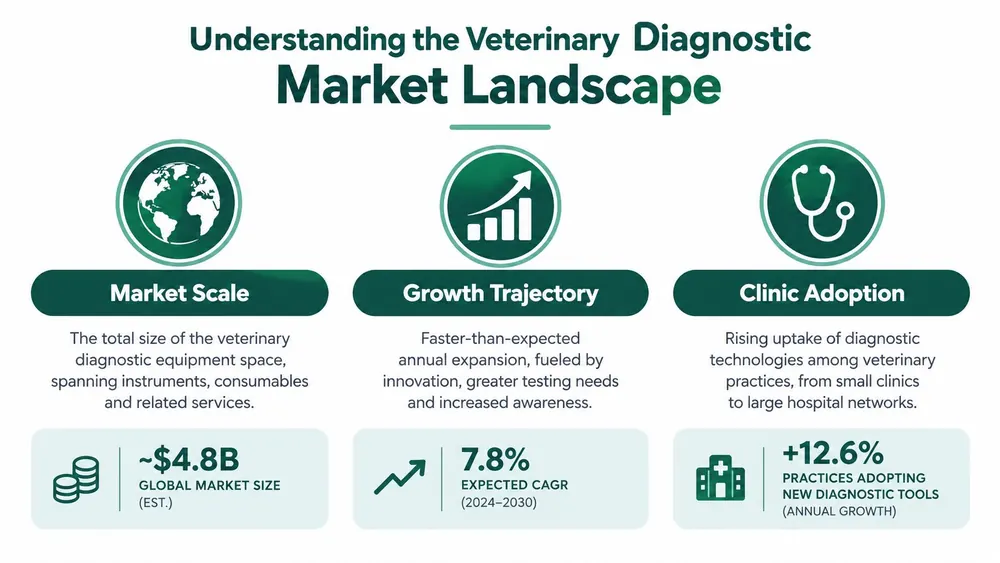
Why market scale changes a clinic purchase
A clinic owner standing in a demonstration room may feel buried under options. One salesperson emphasizes image quality, another highlights automation, and a third focuses on connectivity. The owner sees a collection of devices. The business sees a chain of commitments.
A separate estimate focused specifically on veterinary diagnostic equipment valued that market at USD 1.48 billion in 2025 and projected USD 1.95 billion by 2029, with a 7.1% CAGR, as reported in ResearchAndMarkets' veterinary diagnostic equipment market report. Another independent estimate placed the category at USD 3.94 billion in 2025 and USD 7.34 billion by 2032. The differing estimates reflect different market definitions, but they point in the same direction, sustained expansion and meaningful capital requirements.
The United States was estimated at about USD 4.17 billion in 2026, roughly 43.0% of the global market, in the Fortune Business Insights data. That makes the United States a dominant demand center for clinics investing in imaging, analyzers, and point-of-care systems.
Practical rule: Treat diagnostic equipment as part of your operating model, not as a line item on a vendor quote.
The market's growth creates opportunity, but it also raises the cost of a poorly timed decision. A practice that buys beyond its current case mix may tie up liquidity in idle capacity. A practice that buys too little may send cases elsewhere, repeat tests, or replace a system before it has delivered enough value.
Start with utilization. Review the cases you currently refer out, the tests you delay because results take too long, and the procedures your clinicians avoid because they lack dependable information. Then connect those gaps to equipment categories. Clinical demand should define the purchase. Financing should support it, not create the justification for it.
See what your practice could qualify for
Tell us what you are funding and we’ll connect you with a financing partner who works with veterinary practices. Free, and checking options won’t affect your credit. Compare options in our guide to veterinary equipment financing.
Imaging Systems for Modern Veterinary Clinics
Imaging purchases deserve a disciplined capability review because the equipment affects both diagnosis and daily throughput. Ultrasound, digital radiography, and CT serve different clinical purposes, require different infrastructure, and create different training obligations. Comparing them as if they were interchangeable is a costly mistake.
Match the system to the case mix
Ultrasound suits practices that need dynamic views of soft tissue, abdominal structures, reproductive cases, cardiac assessment, or guided procedures. Portable systems can support room-to-room use, mobile services, and clinics with variable demand. Stationary systems generally make more sense when the practice has a dedicated imaging space, regular trained users, and enough predictable demand to justify keeping the equipment ready.
Digital radiography is the workhorse for many general practices. It supports skeletal assessment, thoracic review, abdominal imaging, and emergency triage. The central buying question is not just image quality. Ask how quickly staff can position patients, capture views, review studies, correct labels, export files, and archive images without adding avoidable steps.
CT belongs in a different planning conversation. It may support advanced imaging and referral-oriented services, but the purchase also brings space, shielding, workflow, staffing, service, and patient management considerations. Don't approve a CT project because the system looks impressive in a demonstration. Approve it only after mapping the clinical demand, referral strategy, facility requirements, and financing capacity.
The veterinary X-ray equipment financing guide can help owners frame the purchase as an equipment and cash-flow decision rather than a simple product comparison.
Imaging system comparison by capability tier
| System Type | Entry-Level Range | Mid-Range Range | Advanced Range | Best For |
|---|---|---|---|---|
| Portable ultrasound | Basic portable capability | Broader imaging and workflow features | Advanced examination and specialty use | Mobile work, smaller practices, focused examinations |
| Stationary ultrasound | Core general-practice imaging | Dedicated imaging workflow | Specialty and referral-oriented services | Practices with consistent room use and trained operators |
| Digital radiography | Essential digital capture | Faster workflow and broader configuration | High-throughput or multi-room operations | General practice, urgent cases, orthopedic assessment |
| CT imaging | Not usually a basic purchase | Practice-specific advanced imaging | Referral-level diagnostic capability | Specialty services and established advanced workflows |
The table's ranges are capability tiers, not price promises. Vendors structure quotes differently, and the total project cost can include installation, room preparation, accessories, software, warranties, training, and service. Compare the installed and operational cost, not the device price printed at the top of a proposal.
Avoid buying for an imaginary future
Owners often over-specify imaging because they want to avoid replacement. That instinct is understandable, but future-proofing only works when the practice has a credible plan to develop the associated service. If no clinician will use advanced features, the premium becomes stranded capital.
Under-specification creates a different problem. A basic system may force clinicians to repeat studies, outsource cases, or work around slow image handling. Ask vendors to demonstrate the exact cases your team handles, including patient positioning, labeling, reporting, export, and archive retrieval. A system that performs well in a polished demonstration may still fail your real workflow.
Laboratory Analyzers and Point-of-Care Testing
In-house laboratory equipment changes the timing of clinical decisions. The financial question isn't whether rapid results sound attractive. It's whether the practice can use the available test menu often enough, accurately enough, and with enough staff consistency to justify the recurring cost of ownership.
Compare capability with workflow
A full in-house laboratory setup may combine hematology and chemistry platforms with sample preparation, quality controls, storage, and result documentation. It can suit a busy general practice or a hospital with frequent preoperative, emergency, and chronic-care testing. The system's footprint matters less than its fit with the clinic's case mix and staffing pattern.
Point-of-care devices take a different approach. They can support chairside decisions, urgent triage, field work, or satellite locations where a larger laboratory workflow isn't practical. Their portability can be valuable, but small hardware doesn't automatically mean low operating cost. Consumables, calibration, operator training, quality procedures, and replacement schedules still belong in the business case.
Manual testing remains relevant in selected workflows, especially where the sample type, species, or clinical question requires professional interpretation. Automation can improve consistency and reduce repetitive work, but it doesn't remove the need for trained oversight. Staff must know when a result needs review, repetition, or referral.
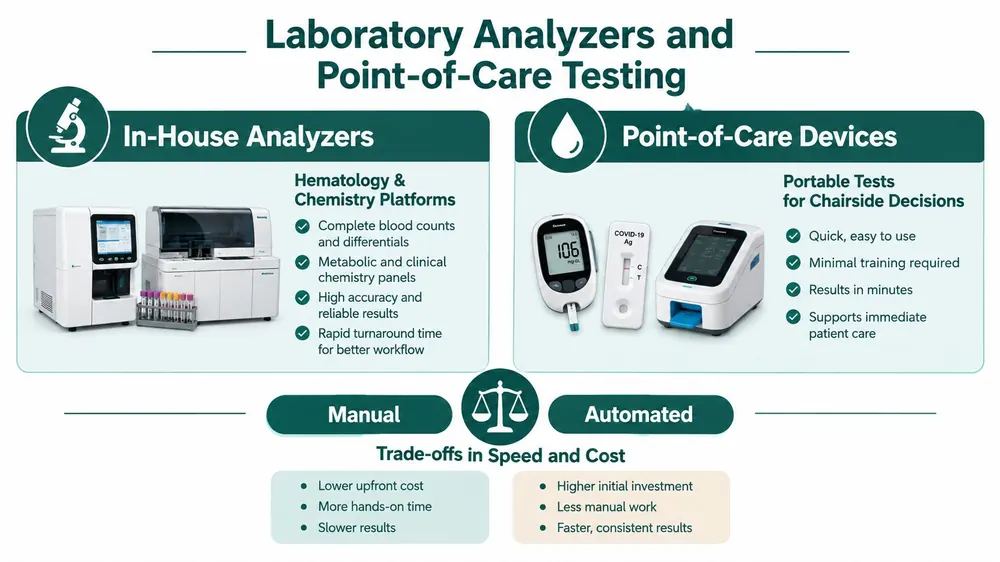
Use a decision matrix before accepting a quote
| Decision Criterion | Full In-House Analyzers | Modular Laboratory Setup | Portable Point-of-Care Devices |
|---|---|---|---|
| Patient volume | Consistently high or broad testing demand | Moderate demand with selected priorities | Variable, urgent, or distributed demand |
| Test menu | Broad routine capability | Focused menu built around common cases | Narrow menu for immediate decisions |
| Staffing | Staff available for operation and oversight | Shared responsibility across trained team | Simple workflow, still requiring competency |
| Referral pattern | Hospital, emergency, or advanced care | General practice with selected in-house testing | Mobile, satellite, or rapid triage services |
| Financial exposure | Higher initial and operational commitment | Staged investment | Lower infrastructure burden, recurring consumable focus |
Before choosing, document the tests your clinicians request most often, the tests currently sent out, and the decisions delayed while waiting for results. Then calculate the full ownership picture without inventing an optimistic utilization rate. Include reagent or cartridge costs, quality controls, service coverage, training, downtime procedures, and staff time.
Protect result quality
A laboratory system isn't valuable if the practice can't produce reliable results. AAVLD laboratory requirements state that veterinary diagnostic laboratories and in-house lab systems must use recognized methods, documented protocols, and processes that support quality and reproducibility. Accredited laboratories must maintain and calibrate equipment, and the equipment and software must achieve the accuracy required for the specific procedure.
That requirement should change the purchasing conversation. Ask who owns calibration responsibility, how maintenance is documented, what happens when quality control fails, and how staff record corrective action. A cheaper analyzer becomes expensive when unreliable results create retesting, treatment delays, or damaged clinical trust.
Monitoring Equipment and Digital Integration Needs
Monitoring equipment should reduce cognitive load during anesthesia, recovery, and critical care. It shouldn't force staff to copy values between screens, re-enter patient details, or maintain separate records because the systems can't communicate.
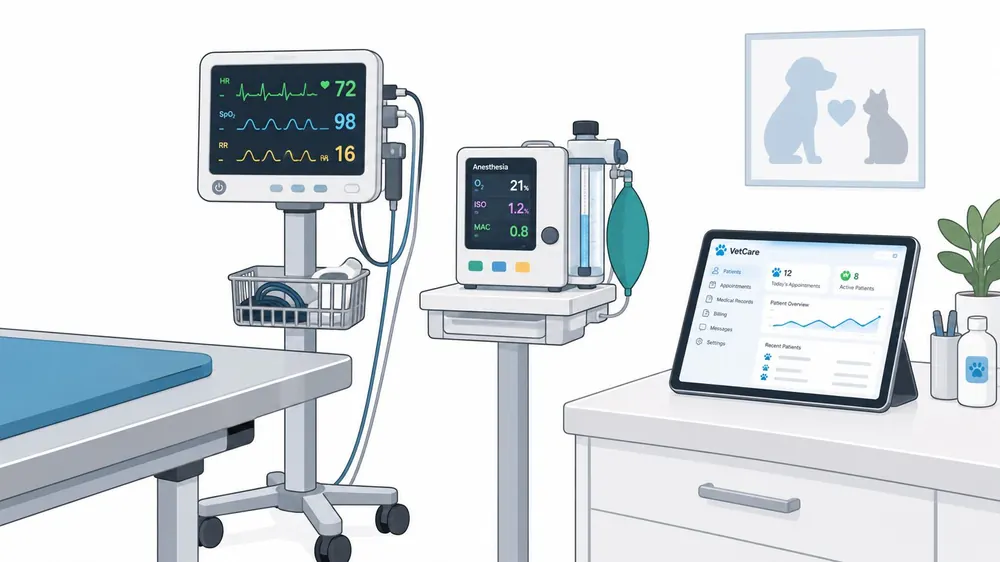
Start with the information path
Map what happens from patient admission to final record storage. Identify where staff enter patient identity, attach measurements, review alerts, save anesthesia records, export imaging, and communicate results. If a vendor can't explain how data moves through that path, the system isn't ready for approval.
Use this checklist during demonstrations and contract review:
- Patient identity: Confirm that the system can associate readings and files with the correct patient without unnecessary duplicate entry.
- Data export: Ask which formats the equipment can export and whether staff can retrieve records without proprietary barriers.
- Interoperability: Verify compatibility with the practice's existing management and medical record environment.
- Alerts: Test whether alarms are configurable, visible, and appropriate for the clinical context.
- Downtime: Document how staff continue monitoring and preserve records if the network or software becomes unavailable.
- Security and access: Clarify user permissions, audit history, backups, and remote support procedures.
- Training: Require role-based onboarding for veterinarians, technicians, assistants, and managers.
- Service response: Put maintenance expectations, replacement parts, loaner equipment, and escalation routes in writing.
For radiography, regulatory compliance isn't optional. Equipment must meet federal and state protective requirements and produce, read, and label good-quality diagnostic radiographs. Industry guidance also recommends that new diagnostic imaging systems support DICOM, which improves interoperability, while lossless compression is preferred for routine veterinary image archiving and teleradiology workflows, as described in Oregon's veterinary radiology rules and guidance.
A polished interface doesn't prove integration. Make the vendor demonstrate a complete record from patient selection through archive retrieval, using your own workflow assumptions.
The following video can supplement a live demonstration of a connected clinical workstation:
Buy the workflow you can operate every day, not the feature list you admire for one afternoon.
Budget for network improvements, dedicated workstations, backup procedures, installation, and training. These costs aren't side issues. They determine whether the new monitoring system saves time.
Equipment Financing Strategies for Veterinary Practices
The financing structure should follow the equipment's useful life and revenue pattern. A diagnostic analyzer used daily can support a different repayment approach from an advanced imaging system that depends on a developing referral service. Matching the payment schedule to realistic utilization protects the practice from paying aggressively for revenue that hasn't arrived.
Build the funding plan in the right order
Begin with the clinical need and an installed-equipment quote. Separate the asset itself from construction, electrical work, shielding, software, service contracts, training, and initial consumables. This prevents a common error, financing the device while leaving the practice to fund the integration work from operating reserves.
Then compare structures. A conventional equipment loan may provide clear ownership and a payment schedule tied to the asset. An SBA-style structure may be relevant when equipment forms part of a broader startup, expansion, or build-out plan. Leasing can preserve upfront liquidity, but owners must examine end-of-term ownership, renewal terms, residual assumptions, and the total cost over the period they expect to use the equipment.
The guide to financing veterinary equipment offers a useful framework for comparing loans, leases, terms, and ownership objectives.
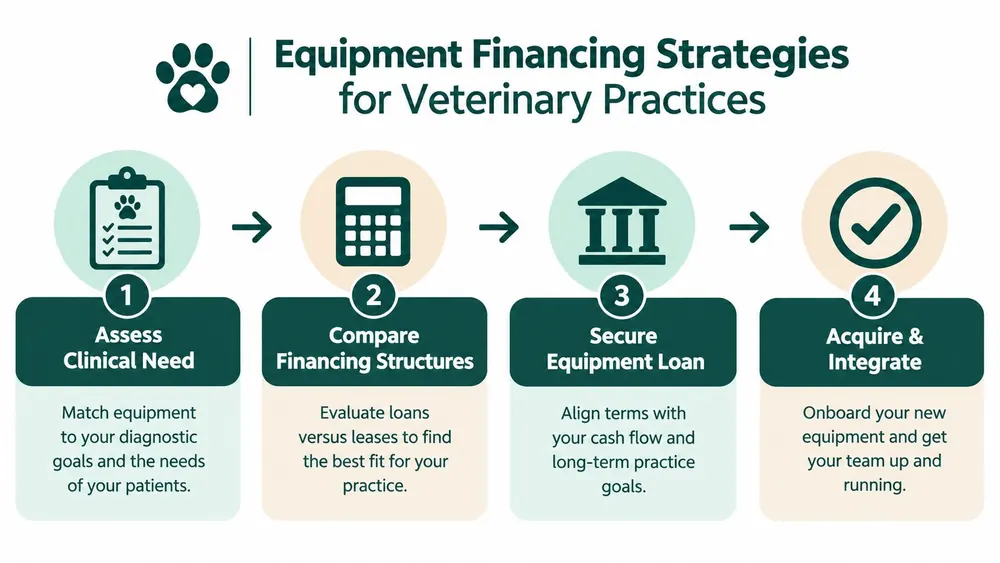
Match structure to equipment category
Imaging systems often require attention to installation, room preparation, service, and training. A structure aligned with the asset's expected useful life can prevent a clinic from facing a large residual payment while the equipment remains clinically necessary.
Laboratory analyzers introduce recurring consumable obligations. A lower payment doesn't solve the problem if the practice hasn't reserved for reagents, cartridges, controls, calibration, and service. Model those operating costs alongside the loan payment.
Monitoring and digital systems may become obsolete or difficult to support before the physical hardware wears out. Ask how software updates, connectivity changes, and replacement components affect the financing decision. Ownership only creates value if the system remains usable.
Working capital should remain separate from the equipment decision where possible. Payroll, pharmaceuticals, inventory, and seasonal variability need flexible liquidity. Using every available reserve for a purchase leaves the practice exposed when collections soften or another essential repair appears.
Negotiate the whole transaction
Don't negotiate only the interest rate. Request a complete cost schedule that identifies origination charges, documentation fees, prepayment terms, collateral requirements, insurance, service obligations, taxes, delivery, installation, and training. Compare the timing of funding with the vendor's deposit and delivery schedule so the practice doesn't carry a payment before the equipment is operational.
A lender or advisor should understand that veterinary revenue can vary by service mix, season, staffing, and expansion stage. That doesn't eliminate repayment risk. It makes the repayment design more important.
Cash-flow discipline: Keep enough liquidity to operate the clinic after the equipment arrives. A diagnostic system can't rescue a practice that has no room for payroll and supplies.
Before signing, prepare a downside plan. Decide which expenses can be delayed, which line of credit supports operations, and how the practice will respond if installation takes longer than expected. A sound financing plan accounts for inconvenience before it becomes an emergency.
Making the Right Equipment Selection for Your Practice
The right purchase sits at the intersection of four realities: clinical need, operational capacity, financial capacity, and strategic direction. If one of those is missing, the proposal is incomplete.
Use a four-part approval test
Clinical need comes first. Identify the diagnoses, procedures, and monitoring decisions the equipment will support. Ask whether the device improves a recurring workflow or merely adds an occasional capability. A system that solves a frequent bottleneck deserves priority over one that serves a rare case.
Operational capacity determines adoption. Name the people who will operate, maintain, interpret, and document results. If only one clinician can use the system, schedule risk becomes part of the purchase. Build training, competency checks, backup coverage, and maintenance into the approval.
Financial capacity sets the boundary. Compare the full project cost with available reserves, expected operating expenses, and other planned investments. Don't use a projected revenue opportunity to justify a payment that the existing practice can't comfortably carry.
Strategic direction determines timing. A growing general practice, a specialty service, a mobile operation, and a multi-location group may need different equipment even when they treat similar patients. Buy for the next credible stage of the business, not an abstract ideal version of it.
Challenge every vendor proposal
Request a side-by-side proposal with identical categories. Require the vendor to identify what is included and excluded, including accessories, installation, software, training, warranties, service response, consumables, and disposal of the old system. Ask for a workflow demonstration using representative cases rather than generic promotional material.
Calculate total cost of ownership across the period you expect to use the asset. Include downtime, calibration, upgrades, replacement parts, staff time, and the cost of sending cases elsewhere when the system isn't available. A lower acquisition price can lose its advantage if it creates frequent interruptions.
For ultrasound purchases, the veterinary ultrasound equipment financing resource can help frame the equipment decision alongside ownership and repayment considerations.
Avoid the two expensive traps
Over-specification consumes capital and creates unused complexity. Underinvestment creates workarounds, referral leakage, and premature replacement. The solution isn't to split the difference. Choose a system with the capabilities your team will use, the capacity your current demand supports, and a clear upgrade path where future growth is credible.
Time the purchase around staffing, construction, training, and cash-flow cycles. Delivery during a renovation may be efficient, but only if the clinic can complete installation and onboarding without disrupting essential care. Delay a purchase when the team lacks the capacity to implement it properly. A functioning basic workflow is better than an advanced system that sits idle.
Real-World Equipment Acquisition Scenarios
Consider a veterinarian preparing a new general practice. The initial equipment list includes digital radiography, ultrasound, laboratory analyzers, patient monitoring, and the network infrastructure needed to connect records. Instead of accepting every premium option, the owner separates essential opening-day capability from services that require a larger future caseload.
The owner obtains an installed quote, includes training and initial consumables, and keeps working capital available for payroll and inventory. Financing covers the equipment project while operating liquidity remains available for the ramp-up period. The result isn't the most elaborate opening package. It's a clinic that can deliver core diagnostics without turning every early operating expense into a financing problem.
An established practice faces a different choice. Its radiography system is becoming difficult to support, clinicians send selected imaging cases elsewhere, and the practice is considering an ultrasound upgrade. The owner compares replacement timing, staff capability, archive compatibility, service coverage, and the likely effect on referrals before choosing a configuration.
Rather than replacing every diagnostic device at once, the practice stages the project. It replaces the system creating the greatest workflow friction, confirms that the network and records environment can support it, and plans training before delivery. The financing schedule reflects the asset's expected use, while a separate working capital facility protects day-to-day liquidity.
The cautionary version is familiar. An owner selects advanced equipment because the technology appears to signal growth, then discovers that staff training, installation, service, and consumables were outside the initial quote. The practice carries the payment, but the workflow never reaches the expected level of use. The problem wasn't ambition. It was approving the asset before approving the operating plan.
Veterinary Practice Loans offers financing for veterinary equipment, working capital, startups, acquisitions, and clinic expansion, with structures designed around practice operations and the expected useful life of the asset. Visit Veterinary Practice Loans to discuss your equipment plan, compare funding structures, and protect cash flow while you build the diagnostic capacity your practice can use.