
Veterinary X Ray Machine Cost: Pricing Guide 2026
 Reviewed by Marie Lokmanyan, Senior Loan Consultant · Updated
Note: Rates, fees, down payments, valuation multiples and lender details below are general market information gathered from public sources, not a quote or offer. Your actual terms depend on the lender, your credit, the practice's financials and market conditions. Confirm current terms with the lender before you rely on them.
A typical installed veterinary digital radiography suite costs between $40,000 and $80,000, while basic portable units start much lower and advanced stationary systems can reach $70,000 or more. The right veterinary X ray machine cost depends on whether you need occasional imaging, a dependable daily workflow, or a high-throughput room built around complex cases.
You're probably looking at equipment because the current setup has become a bottleneck. Images take too long to acquire, staff repeat studies because positioning is difficult, or your practice is sending cases elsewhere that you'd rather diagnose in-house. The purchase quote may look straightforward, but the decision involves the detector, generator, software, installation, service coverage, downtime risk, and the financing structure that keeps cash available for payroll and patient care.
A low sticker price can be sensible for a small or mobile practice. It can also become an expensive mistake if the equipment can't handle your caseload. This guide compares the major equipment tiers, separates purchase price from ownership cost, and connects clinic growth stages with practical ways to fund the investment.
Veterinary X Ray Machine Cost Overview
The buying moment usually arrives after a series of small frustrations. A portable unit gets moved repeatedly between rooms, a detector slows down the team, or the practice starts turning away imaging work because the existing system can't keep up. At that point, the important question isn't merely, “How much is an X-ray machine?” It's, “Which configuration will support the work we expect to perform without forcing another upgrade too soon?”
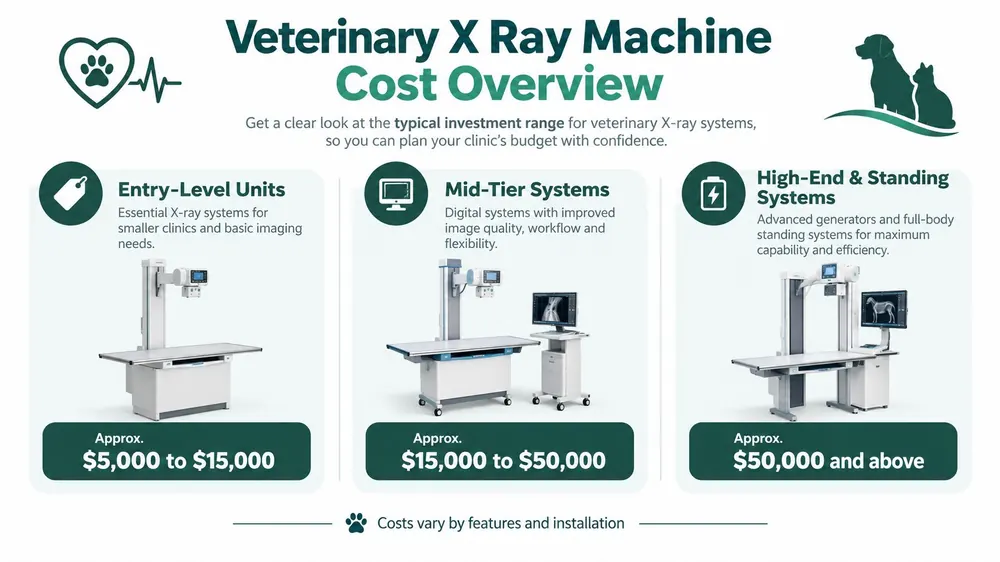
The clearest benchmark is a complete installed digital radiography suite at approximately $40,000 to $80,000. That package generally includes the generator, detector plate, and imaging software. A single digital radiography system may be priced between $30,000 and $90,000, while broader market guidance places veterinary digital systems between $15,000 and $80,000, depending on configuration, workflow features, and installation scope, as outlined in this veterinary imaging equipment financing guide.
Why quotes vary so widely
Two systems can both be described as “digital” while delivering very different workflows. A compact portable unit may combine a generator, detector, and software in a package designed for flexibility. A stationary suite may add a fixed table, more powerful generator, larger detector, positioning controls, dedicated workstation, room preparation, and installation support.
Read every quote as a list of included components rather than as one total number. Ask whether it covers:
- Generator and tube: Confirm the generator type, power requirements, exposure controls, and replacement coverage.
- Detector: Check the panel size, wireless or tethered design, durability protection, warranty, and replacement terms.
- Software: Identify image acquisition, measurement, storage, reporting, updates, and integration costs.
- Installation: Verify whether delivery, assembly, electrical work, room preparation, calibration, and staff training are included.
- Support: Ask how technical problems are handled, how quickly service responds, and what happens during extended downtime.
Practical rule: Compare complete working systems, not equipment labels. A detector price that excludes the generator, software, or installation isn't comparable with an installed suite quote.
Before requesting financing, decide whether the practice needs portability, a dedicated radiography room, or a system capable of supporting a larger future caseload. That decision narrows the budget more effectively than starting with a brand or a monthly payment.
See what your practice could qualify for
Tell us what you are funding and we’ll connect you with a financing partner who works with veterinary practices. Free, and checking options won’t affect your credit. Compare options in our guide to veterinary equipment financing.
Equipment Tiers and Price Ranges
The equipment tier should follow the way your team works. Price differences reflect architecture and capability, not just branding. Detector quality, workflow automation, image acquisition speed, room design, installation, and service scope all influence the cost, according to this veterinary radiography pricing overview.
A basic portable setup suits practices that need flexibility or perform imaging in multiple locations. A stationary system suits a clinic where radiography happens throughout the day and staff benefit from a fixed table, predictable positioning, and faster room turnover. The best choice isn't the most advanced system your budget can technically absorb. It's the least expensive system that meets your clinical and operational requirements without creating avoidable friction.
| Equipment tier | Typical price range | Best for |
|---|---|---|
| Entry-level portable veterinary unit | $10,000 to $20,000 | Mobile work, limited imaging volume, small spaces, and practices beginning a digital transition |
| Mid-range digital system | $15,000 to $30,000 | General practices needing better workflow, image quality, and regular in-house radiography |
| Advanced stationary digital system | $35,000 to $70,000 or more | High-volume hospitals, referral work, orthopedic imaging, and dedicated radiography rooms |
Portable systems
Portability has practical value when the patient can't easily be moved, when several rooms share one unit, or when the clinic operates across locations. The trade-off is that portable equipment may involve more setup between studies, battery management for wireless components, and greater exposure to handling damage.
A portable system can be the right starting point for a solo veterinarian or a clinic with modest imaging demand. It becomes less attractive when technicians spend much of the day transporting equipment, positioning patients around a limited detector area, or repeating images because the workflow is inconsistent.
Mid-range digital systems
Mid-tier equipment typically adds a more capable detector, better software, stronger workflow support, or a more integrated generator and table. The value comes from reducing operational steps. When the team can acquire, review, store, and share an image without moving between disconnected systems, each study places less strain on the schedule.
This tier often works well for a general small animal practice that has outgrown basic equipment but doesn't need a premium room. It also gives owners a way to improve consistency without committing to the full infrastructure of a high-end stationary installation.
Advanced stationary systems
Stationary systems cost more because they support a room-based workflow. A larger or higher-quality detector, automated positioning, generator capacity, integrated table, software controls, and installation requirements all contribute to the price. Those features matter when imaging is frequent enough for small time savings to accumulate across the day.
The additional spend is most defensible when radiography volume is high, orthopedic work is central to the practice, or multiple team members need to use the room efficiently. A premium system in a low-volume clinic may provide impressive capability while leaving much of that capability unused.
Hidden Costs and Total Ownership Expenses
The purchase price is only the first line of the budget. A clinic can buy an inexpensive system and still spend heavily on maintenance, software, repairs, detector risk, and lost appointment capacity. That's why the useful comparison is total cost of ownership, not merely the amount printed on the first quote.
Guidance comparing analog, computed radiography retrofits, and digital radiography places analog systems near $3,000 to $5,000, while CR retrofits and mid-range DR systems can reach $25,000 to $110,000. The same guidance estimates detector replacement above $10,000 to $15,000 and annual maintenance or support at approximately 5% to 10% of the base price, as described in this veterinary radiology equipment cost resource.

The expenses that deserve a line item
An analog unit may look attractive because the initial commitment is lower. But film handling, manual processing, storage, retakes, and slower image review can create operational costs that don't appear in the purchase quote. A CR retrofit may preserve parts of an existing setup, but it still introduces software, reader, maintenance, and workflow considerations.
DR systems reduce some manual steps, yet they don't eliminate ownership risk. Detectors are valuable components, software may require ongoing support, and a failure can interrupt the entire imaging workflow. Ask the seller to identify the cost and expected availability of replacement parts before signing.
Build the budget around these categories:
- Service and maintenance: Clarify scheduled maintenance, emergency support, response times, and exclusions.
- Detector exposure: Review accidental damage, drop coverage, deductibles, and replacement conditions.
- Software and storage: Confirm licensing, updates, image archiving, workstation requirements, and integration.
- Facility work: Include electrical preparation, shielding requirements where applicable, room alterations, delivery, and calibration.
- Downtime: Estimate the clinical and scheduling impact if the system is unavailable and no backup exists.
- Training: Confirm who trains the team and whether refresher support is included.
A useful planning model separates one-time acquisition costs from recurring operating costs and failure reserves. Owners should also consider the equipment's expected useful life when choosing repayment terms, as discussed in this guide to the useful life of veterinary equipment.
Why the cheapest option can cost more
The cheapest equipment works when it matches the practice's actual needs and receives dependable support. It fails financially when the team avoids using it because the workflow is cumbersome, when repeated studies consume appointment time, or when repairs arrive without a reserve.
The veterinary X-ray market is estimated at $0.86 billion in 2026 and projected to grow at approximately 6.05% CAGR through 2031, according to the cited market guidance. That projection doesn't prove that every clinic should buy premium equipment, but it does reinforce a practical shift. Owners increasingly evaluate imaging as a productivity asset, not just as a fixed purchase, because system availability and workflow affect how the practice delivers care.
Financing Options for Veterinary Clinics
A two-doctor clinic rarely makes an imaging decision in isolation. The owners may be planning an expansion, replacing another major asset, hiring staff, or protecting reserves for seasonal fluctuations. Paying cash for a machine can feel financially responsible, but draining liquidity may leave the practice exposed when an unrelated repair or payroll pressure arrives.
For budgeting, a complete installed digital suite is commonly placed at $40,000 to $80,000, while many veterinary DR systems fall in the $25,000 to $50,000 range. The difference usually comes down to whether the quote includes the generator, flat-panel detector, imaging software, installation, and related workflow components, as explained in this veterinary X-ray machine price guide.
A representative clinic decision
Consider a two-doctor practice with a growing imaging caseload and enough work to justify a dedicated room. The owners receive one quote for a portable digital system and another for a complete installed suite. Rather than choosing the lower total immediately, they ask which option supports their expected workflow, what installation includes, and how much cash the practice should retain after closing.
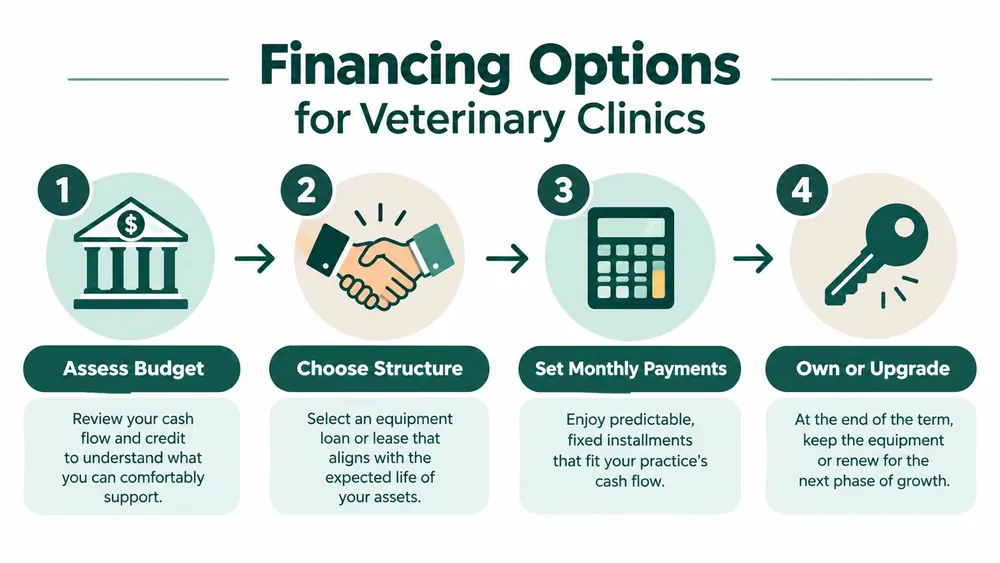
An equipment loan may suit the clinic if the owners want to own the system and keep the financing tied to the asset. A lease may be useful when preserving cash or planning a future upgrade matters more than immediate ownership. A broader practice loan can make sense when the imaging project is part of a build-out, relocation, or expansion that includes several uses of capital.
The right structure depends on the practice's cash flow, credit profile, growth plans, and the terms offered. Owners should compare the total repayment, fees, end-of-term obligations, early payoff provisions, tax treatment with their advisers, and what happens if the equipment becomes obsolete before the financing ends.
The monthly payment should fit the practice's ordinary cash flow, not depend on an optimistic imaging forecast.
Match the structure to the growth stage
Established single-location clinic: An equipment loan can preserve operating reserves while funding a defined purchase. Fixed payments make budgeting easier, but the owners should include service and replacement reserves in the monthly plan.
New practice or major build-out: Imaging may need to be financed alongside construction, initial inventory, staffing, and other opening costs. Separating the equipment decision from the larger capital plan can produce a payment that looks manageable but strains the total project budget.
Growing clinic with uneven revenue: A working capital facility may protect liquidity while the practice absorbs installation disruption and trains the team. It shouldn't replace a clear equipment budget, but it can reduce pressure on operating cash.
Multi-location or expanding group: A broader expansion structure may be more practical than treating every machine as an isolated purchase. The owners can assess how equipment, rooms, staffing, and projected demand work together.
Veterinary-focused financing guidance can help owners compare equipment financing and leasing structures rather than accepting the first payment option offered with the machine. Bring the lender a complete project budget, including equipment, installation, software, training, service, and any facility work.
The embedded resource below can help frame the financing conversation before requesting proposals.
Ask for a quote that shows the financed amount separately from interest and fees. That transparency lets you compare a lower monthly payment with a longer repayment period against a higher payment that may reduce total financing cost. Don't choose based on payment size alone.
Matching Equipment Choices to Clinic Size
Clinic size provides a starting point, but caseload, case mix, and workflow determine the better equipment choice. A solo veterinarian may perform fewer studies yet need a portable unit for farm calls, home visits, or shared rooms. A compact hospital may have enough imaging demand to justify a fixed room despite operating from one location. A multi-location group may value standardization and service coverage more than the lowest purchase price.
Portable veterinary X-ray sets typically run $10,000 to $20,000 for a complete unit, while self-contained portable systems in buying guides cluster around $11,500 to $13,400, as shown in this veterinary digital X-ray pricing reference. Treat those figures as equipment-budget ranges, not interchangeable quotes. A low-cost analog or CR retrofit can reduce the initial outlay, but slower processing, additional handling, and older components may widen its ownership cost compared with a full digital suite.
Solo and mobile practices
A solo veterinarian should begin with the question, “Where will imaging happen?” If the answer includes multiple rooms, farm calls, or satellite work, portability may deliver more value than a fixed table. A portable system can also avoid dedicating a room to radiography, which matters in a compact facility.
The risk is choosing equipment that handles current demand but becomes awkward as the practice grows. Check detector size, patient range, battery or cable requirements, image storage, and compatibility with the existing record and image workflow. Confirm how the unit will be moved, protected, and serviced between locations.
For uncertain volume, a staged purchase can preserve cash and leave room to upgrade after the practice has measured actual demand. The cheapest portable option is rarely the lowest-cost choice if staff must repeat studies or wait for image processing.
Growing general practices
A growing practice should evaluate throughput rather than purchase price alone. If technicians regularly wait for the machine, reposition equipment, or repeat studies, a mid-range digital system may fit better than another basic portable unit. A retrofit can appear attractive when the existing generator or room is usable, but compare its detector, software, service requirements, and expected downtime with a complete digital setup.
Ask the team to describe a typical busy day. Record how often staff move the equipment, how long image review takes, and whether imaging delays other appointments. These observations are more useful than a generic recommendation based only on the number of veterinarians.
This stage often suits an upgrade that removes a specific bottleneck rather than the largest system the clinic can buy. Match the equipment to expected caseload growth, available operating cash, and the time required for staff training.
Hospitals and multi-location groups
A hospital with regular orthopedic, emergency, or referral imaging may benefit from a stationary suite. Its value comes from predictable positioning, room availability, consistent training, and readiness for repeated studies. Higher acquisition cost can make sense when the equipment replaces frequent transfers, delays, and repeat exposures.
Multi-location groups should assess standardization across sites. A common workflow, shared image access, and consistent training can simplify staffing and quality control. Each location still needs its own review of space, electrical capacity, patient mix, and caseload. Copying one purchase across every site can create unnecessary ownership cost.
Use this decision filter:
- Clinical need: List current studies and the examinations the team expects to add.
- Throughput: Identify delays caused by imaging, repositioning, or staff movement.
- Space: Decide whether a dedicated room is realistic.
- Mobility: Determine whether the unit must travel between rooms or locations.
- Growth: Choose between current-demand coverage and planned expansion capacity.
- Ownership risk: Compare service, detector protection, software, training, and downtime terms before accepting the lowest quote.
A phased approach fits limited volume and uncertain growth. A complete room fits consistent demand when the current workflow is already costing clinical time.
Action Plan for Equipment Investment Decisions
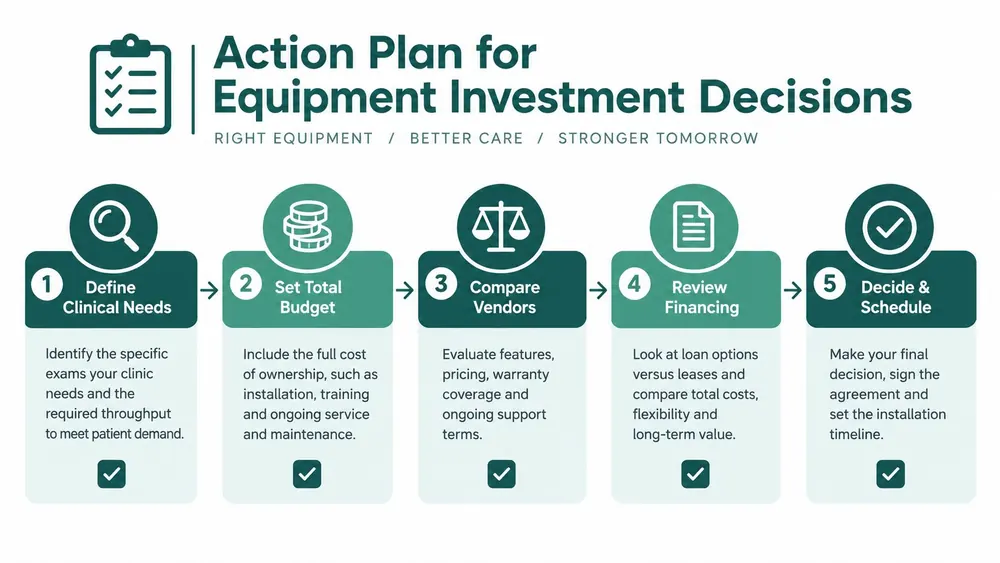
A sound purchase begins before the first vendor demonstration. The owner should define the clinical requirement, build a complete budget, and test every assumption against the daily workflow. Financing comes after those decisions, not before them.
Start with a written equipment brief. Include the patient sizes you see, studies you perform, expected mobility, available room, image storage needs, and the people who will operate the system. Ask technicians to identify the current workflow failures because they often know which feature will save time and which impressive option won't be used.
Build a quote that reflects reality
Request itemized proposals from more than one source, but compare like with like. Each proposal should identify the generator, detector, software, workstation, installation, training, warranty, service, delivery, and facility requirements.
Use this checklist before reviewing payment terms:
- Clinical specification: Confirm detector size, portability, image workflow, and patient range.
- Ownership budget: Add installation, software, service, training, storage, and a repair reserve.
- Downtime plan: Ask about response times, loaner equipment, remote support, and replacement parts.
- Contract review: Check warranty exclusions, renewal terms, accidental damage, and end-of-term conditions.
- Facility readiness: Verify power, room layout, shielding advice, network access, and delivery logistics.
- Team adoption: Assign training time and name the person responsible for workflow standards.
Choose funding after the numbers are complete
Once the full project cost is known, compare cash purchase, equipment financing, leasing, and broader practice funding. Preserve enough operating liquidity to handle ordinary expenses and unexpected clinical needs. A low payment isn't automatically affordable if the term extends beyond the equipment's useful working life or if a balloon obligation appears at the end.
Use a veterinary equipment financing calculator to test payment scenarios, then ask lenders to show the total cost of capital, fees, repayment schedule, and early payoff terms in writing. Review the proposal with your accountant and confirm that the structure fits the practice's revenue pattern.
Make the final decision in this order:
- Define the required workflow.
- Set the all-in project budget.
- Compare complete equipment packages.
- Verify service and warranty protection.
- Select financing that preserves liquidity.
- Schedule installation, training, and a backup plan.
Don't sign until the quote reflects the room you'll operate, the support you'll receive, and the costs you'll carry. A veterinary X ray machine becomes a productive asset only when the team can use it consistently, maintain it predictably, and pay for it without destabilizing the practice.
Veterinary Practice Loans provides financing for veterinary equipment projects, including imaging purchases, with structures designed around clinic cash flow and the expected life of the asset. Visit Veterinary Practice Loans to discuss an equipment loan or lease and bring your complete X-ray project budget to the conversation.